The six states of a Story
A Story goes through exactly six states in Betterplan, no more. That is deliberate: too many intermediate stops such as "In review" or "Ready to deploy" hide unfinished work and tempt you to start new things instead of finishing existing ones. Betterplan follows the principle Stop starting, start finishing.
The states
The six states split into two phases that take place within a single Story (see Discovery and Delivery):
| Phase | State | Meaning |
|---|---|---|
| Discovery | Idea | Captured, but not yet picked up. One sentence is enough. |
| Discovery | Draft | Details and requirements are being refined. |
| Discovery | Ready | Discovery is done: the Story is clear enough to be built. |
| Delivery | Todo | Planned, but not started yet. |
| Delivery | Doing | Work is in progress. |
| Delivery | Done | The implementation is finished. |
The names match the column headings in the interface. New Stories start at Idea.
Separate from these there is Open and Closed, a second, deliberately independent axis.
Typical transitions
The normal path leads step by step from left to right: Idea → Draft → Ready → Todo → Doing → Done.
- Idea → Draft: You decided to clarify the Story further. That is a conversation that takes time, not a form. Collect open questions in the description.
- Draft → Ready: Open questions are answered or deliberately accepted as assumptions. Only now is the Story buildable.
- Ready → Todo: The team takes the Story into implementation. The global priority helps: whatever is furthest along comes first, and within a state the order in the Backlog counts.
- Todo → Doing → Done: The team works the Story off, broken into Workitems if needed.
Moving backwards works too: if a Story turns out not to have been clear enough, move it to an earlier state. The points in time at which a Story first reached a state are kept for the reports.
The state determines the priority
A Story's maturity is also its most important priority criterion, in the spirit of Stop starting, start finishing: Done (still open) before Doing before Todo before Ready before Draft before Idea. A Story that is already in progress therefore always comes before one that is still an idea, no matter where the two stand in the Storyboard. Only within a state does the top-to-bottom order in the Backlog decide. The rule and an example are under Prioritizing.
You change the state by dragging the card to another column in the Kanban or by choosing the progress in the task's edit sheet (Progress).
Where the states show up
The six states are visible in several views:
- Backlog Kanban (Prepare): Each state is its own column, the Discovery columns Idea, Draft, Ready on the left and the Delivery columns Todo, Doing, Done on the right. In addition there is the Closed column, which you can expand when needed. The left part with Idea is shown under Discovery and Delivery.
- Iteration Board (Build): It distinguishes the Discovery Track and the Delivery Track. The columns of the Delivery view are Todo, Doing and Done. The Workitems move there as well (see Iteration Board).
- Storyboard (Scope): Every Story card shows its state as a badge, for example Done with a green check.
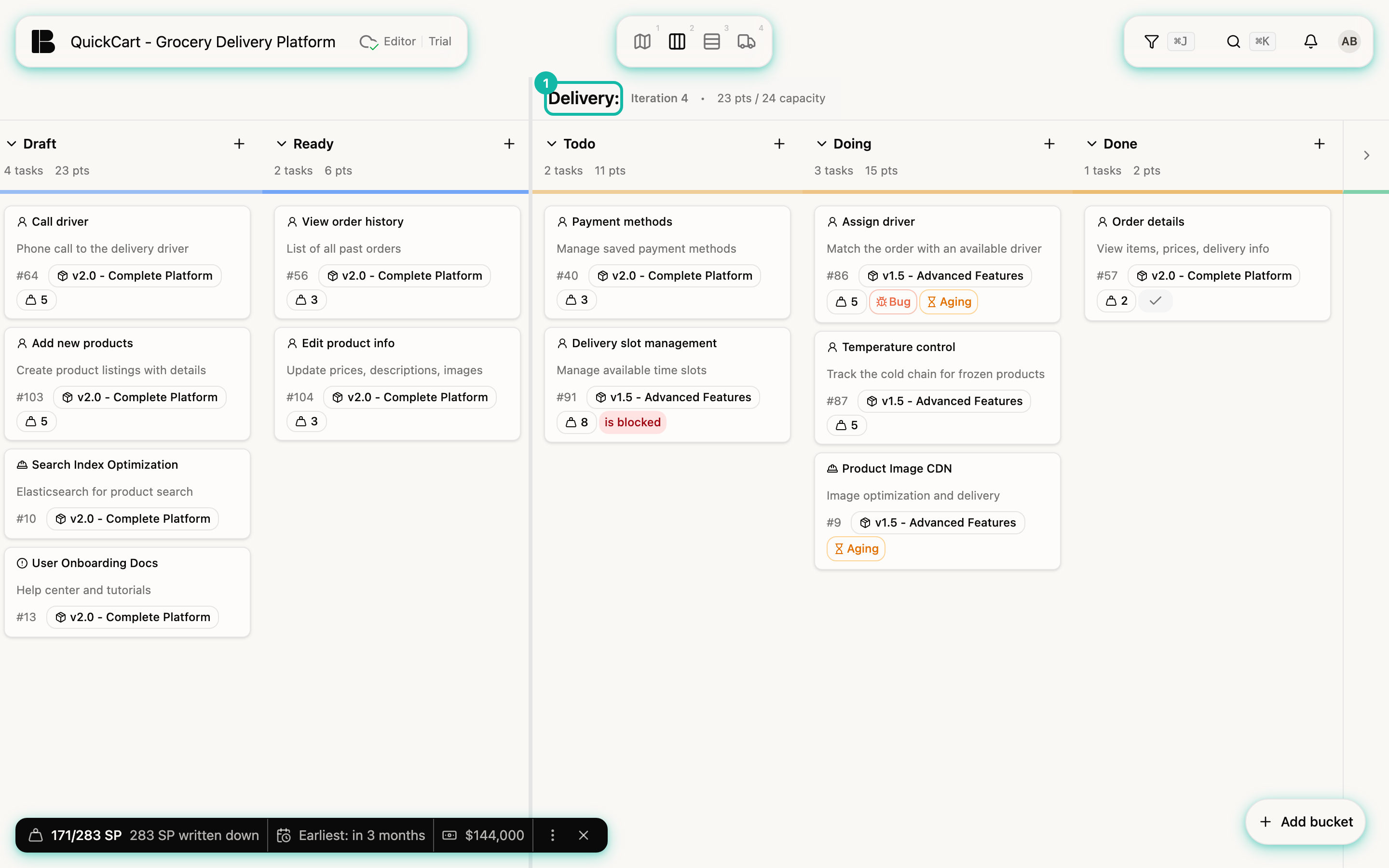
A Workitem only goes through Todo, Doing and Done. Clarification and prioritization happen on the Story above it. Workitems start at Todo.
Epics and Initiatives have no state of their own. They only structure, so they show no progress selector.
Note: aging Stories
A Story that stays in the same state for too long gets the Aging marker (see Iteration Board). How long Stories take overall is shown in Flow. The deadline gets shorter the further along the Story is: an idea may rest for a long time, a Story in Delivery should move on within one iteration. The marker is a nudge to clean up, not an error.